
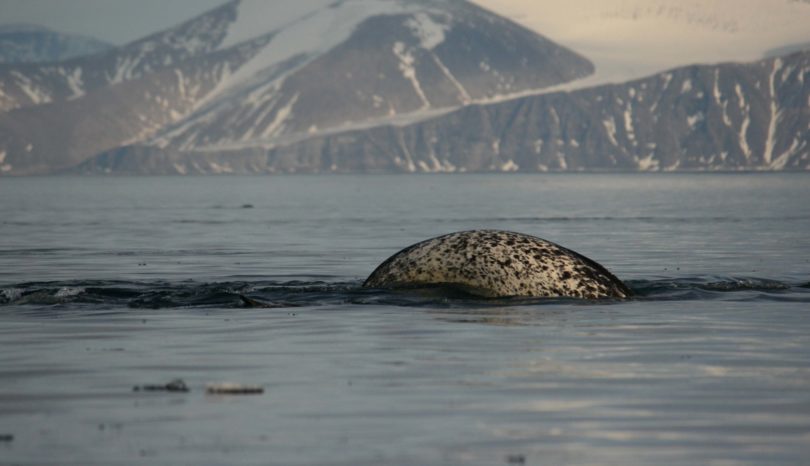
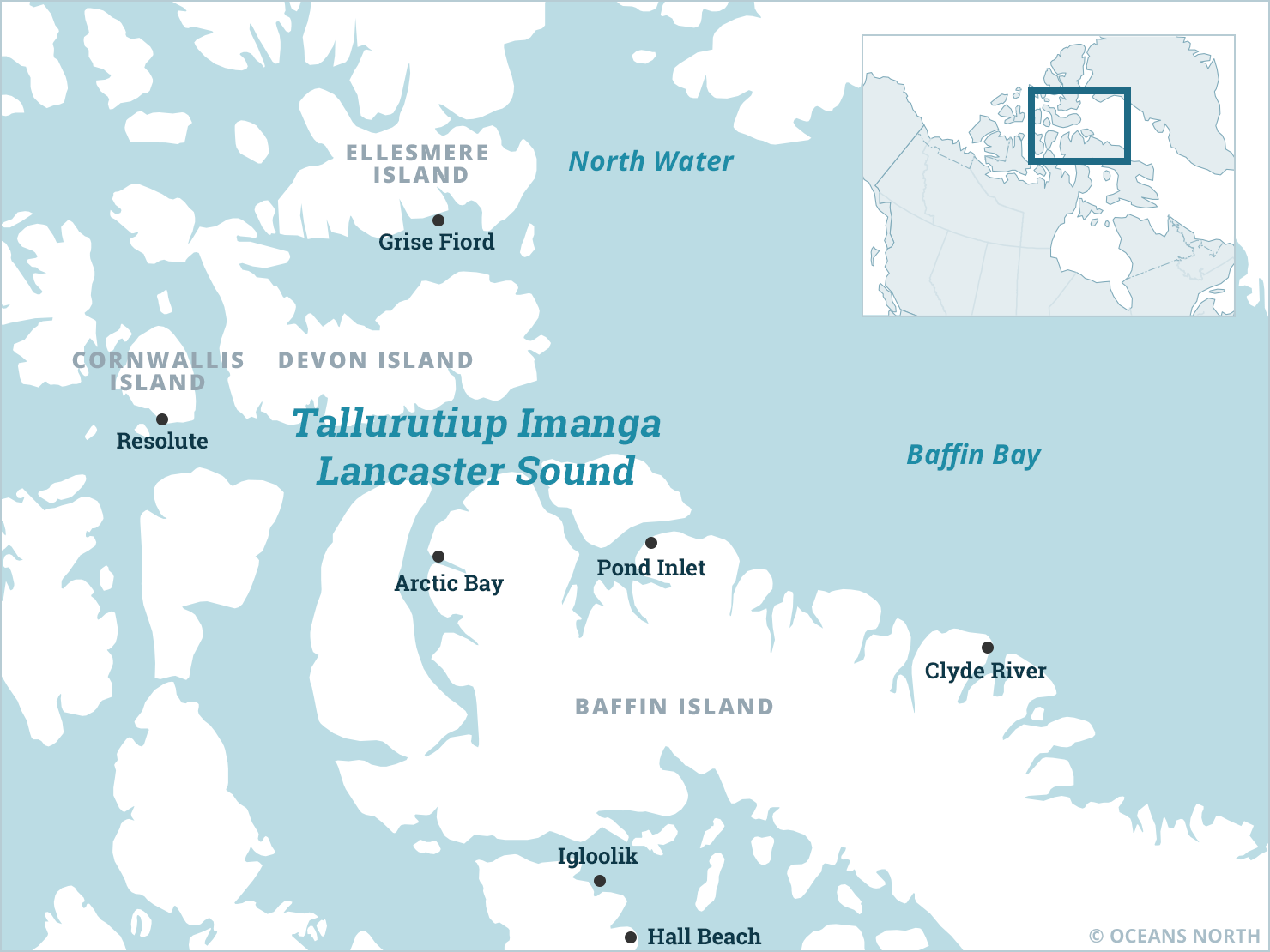
Located at the eastern entrance to the Northwest Passage, Tallurutiup Imanga, also known as Lancaster Sound, is a region of spectacular fjords, jagged mountains and tidewater glaciers and is home to Inuit who have long relied on its rich biological productivity. Recognized for its environmental and cultural importance, Tallurutiup Imanga is the site of a national marine conservation area (NMCA) that protects its waters for future generations.
A Rich Marine Ecosystem
Each spring and autumn, large numbers of narwhal and bowhead whales migrate through Tallurutiup Imanga. The return of the whales sustains the traditional harvest season for the five communities surrounding Lancaster Sound: Pond Inlet, Grise Fjord, Clyde River, Resolute Bay and Arctic Bay. Hunting whales, seals and other marine mammals is an important part of Inuit culture and a source of “country food” that provides crucial nutrition for northerners.
Throughout Tallurutiup Imanga, polynyas, or open-water areas surrounded by ice, provide oases where wildlife can feed, mate and overwinter. Within the polynyas, upwellings of warm water and sunlight create an explosion of plankton that supports vast schools of Arctic cod, a source of food for marine mammals. About a third of North America’s beluga whales, once-endangered bowhead whales, walrus, ringed harp and bearded seals and about 85 per cent of the world’s narwhal summer in Tallurutiup Imanga where they feed, nurse and rest. Vast numbers of dovekie, Canada’s murre, kittiwake, guillemot, sea ducks and Northern Fulmars also feed and nest in this region.
Path to Protection
For the last few decades, commercial interests have clashed with those seeking to protect Tallurutiup Imanga. In the late 1960s, Canada’s federal government granted oil exploration permits for 14 million offshore acres at the mouth of Lancaster Sound to a dozen oil companies. The government did this without consulting Inuit communities. In 1974, the first approved exploratory well drilled to an unprecedented 914 metres, a depth that had never been reached in the Arctic.
After strong opposition from Inuit communities, the government consulted with local leaders and conducted broader regional studies. In 1987, Parks Canada proposed the creation of a national marine conservation area in Lancaster Sound and began a feasibility study. Following the Nunavut Lands Claim Agreement in 1993, consultations with Inuit communities concluded that there was strong support for the protection of Lancaster Sound from potentially harmful oil and gas activities.
In 2009, the federal government announced a $5 million feasibility study for the national marine park. The following year, seismic testing to assess potential oil and gas resources was scheduled for Tallurutiup Imanga. But nearby Inuit communities protested the testing and obtained a court injunction in August 2010 to stop the tests. In December of that year, the federal government proposed boundaries for the NMCA and began negotiations with the Qikiqtani Inuit Association.
In 2015, Royal Dutch Shell relinquished its oil leases at the eastern edge of Lancaster Sound, allowing the proposed protected area to grow from 41,000 square kilometres to 109,000 square kilometres.
Lancaster Sound’s ecological importance is recognized internationally, with proposals to protect this region as a world biological reserve and a United Nations World Heritage site. In 2019, Inuit and the federal government signed an agreement establishing the Tallurutiup Imanga National Marine Conservation Area that will protect this rich marine ecosystem and help mitigate the impacts of climate change.
Opportunities
Oceans North supports two primary efforts toward marine and community protection in this region:
- Oceans North supports the efforts of Parks Canada and the Qikiqtani Inuit Association to advance the comanagement of the Tallurutiup Imanga (Lancaster Sound) as a model NMCA that employs Inuit knowledge and skills.
- At the same time, Oceans North supports sustainable shipping practices from the nearby Mary River iron ore mine that do not harm traditionally harvested marine mammal and bird populations or destabilize sea ice that local residents use as travel routes.
Related Resource
Tallurutiup Imanga
Poetry and images explain why Lancaster Sound, known now as Tallurutiup Imanga, needs to be protected.
Video © The Pew Charitable Trusts and Ducks Unlimited.